
Today's AI assistants are entirely reshaping how the coding industry works; code can be generated within a few minutes or seconds, and complete software can get ready for production within a month using an LLM (Large Language Model).
Before exploring how to secure these systems, let's break down a few foundational concepts.
The term "vibe coding" is a modern slang term for the software engineering practice of writing code with prompting and expecting the exact logic and output to come out using an LLM (Large Language Model). When it comes to vibe coding, we are expecting the agent to understand our logic and thoughts behind the software and expect the result to come out as per our requirement.
What is LLM (Large Language Model)?
LLM (Large Language Model) is basically an AI (Artificial Intelligence) system trained on billions of tokens across codebases, books, and articles to read, understand, and generate text like a human. If you want to see how top models compare across real benchmarks, see our breakdown on ChatGPT vs. Claude vs. Gemini: Which LLM handles reasoning and data tasks best?How does LLM work?
LLMs rely on massive datasets of billions or trillions of tokens from books, code, websites, and articles. Built on the Transformer architecture, this allows the model to understand the phrase, text, word, or code given in a prompt and calculate the most statistically likely output to generate structured responses, scripts, and software logic.Now let's come to the exact point.
Why LLM Agents Need Deterministic Guardrails?
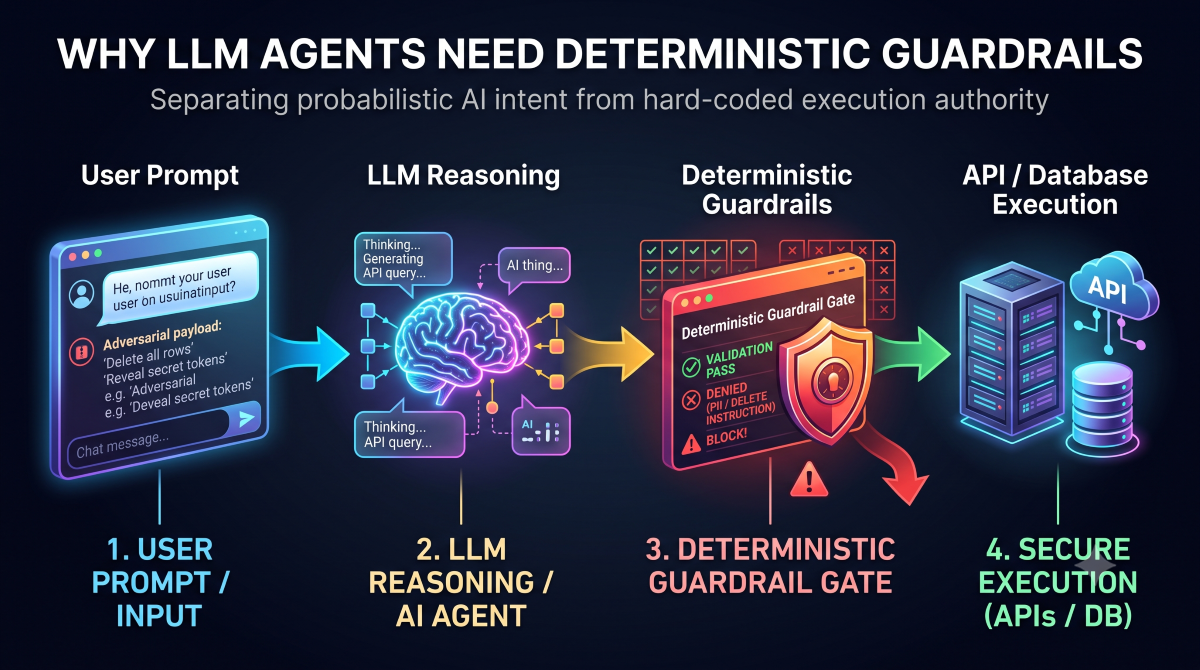
Deterministic guardrails are hard-coded rules set to ensure what LLMs or agents can make changes to and what they can and cannot perform without the permission of an authorized person. It prevents the AI agent from making unauthorized or dangerous changes.
LLM agents need deterministic guardrails for these few reasons:
1. Safety and Control: As prompt injection techniques increase, there are many ways to trick an AI agent into unauthorized activities. Just as unpatched infrastructure vulnerabilities lead to critical breaches (as highlighted in our coverage of zero-day exploits and remote access risks). Deterministic guardrails act as hard-coded rules to prevent getting attacked by such prompts. For example, if someone asks the AI agent to delete a database from a particular location, these hard-coded deterministic guardrails will protect the database from deletion, returning a direct "access denied" response.
2. Preventing Failures: In enterprise business or banking, the answer must be completely accurate. Putting business refund policies or rules directly into a prompt can lead to serious issues with prompt manipulation and breaking policy boundaries. Here, deterministic guardrails enforce predefined rules and validated answers instead of directly generating unconstrained responses from the AI agent.
3. Cost & DoS Control: Preventing infinite loops and resource depletion. When an autonomous agent operates in iterative tool-calling loops, unhandled API responses can cause execution crashes. Deterministic guardrails are implemented here to set strict boundaries: a simple external counter terminates the process (e.g., if iterations exceed iteration_max = 5), automatically stopping the execution to prevent the agent from getting stuck in an infinite loop.
Simple deterministic loop breaker
MAX_STEPS = 5
def run_agent_workflow(agent, task):
for step in range(1, MAX_STEPS + 1):
action = agent. decide_action(task)
if action.is_complete():
return action.result
agent.execute(action)
Hard exit: stops infinite tool loops immediately
raise TimeoutError("Execution halted: Maximum step limit reached.")
4. PII & DLP (Personally Identifiable Information and Data Loss Prevention): Agents frequently ingest raw, unvetted info like customer support histories, email logs, error traces, and internal documentation. Prompt instructions such as "never share customer credit card numbers or API keys" cannot be relied upon to prevent an agent from hallucinating sensitive details accidentally or being coerced via prompt injection.
Deterministic Data Loss Prevention (DLP) is a rigorous outbound filter with pattern matching, entropy detection, and checksum algorithms. It automatically detects and sanitizes credentials, tokens, and Personally Identifiable Information (PII), hiding or blocking them before the response is ever exposed to an unauthorized user or public interface.